Epictetus | The Manual | Enchiridion | 21-30
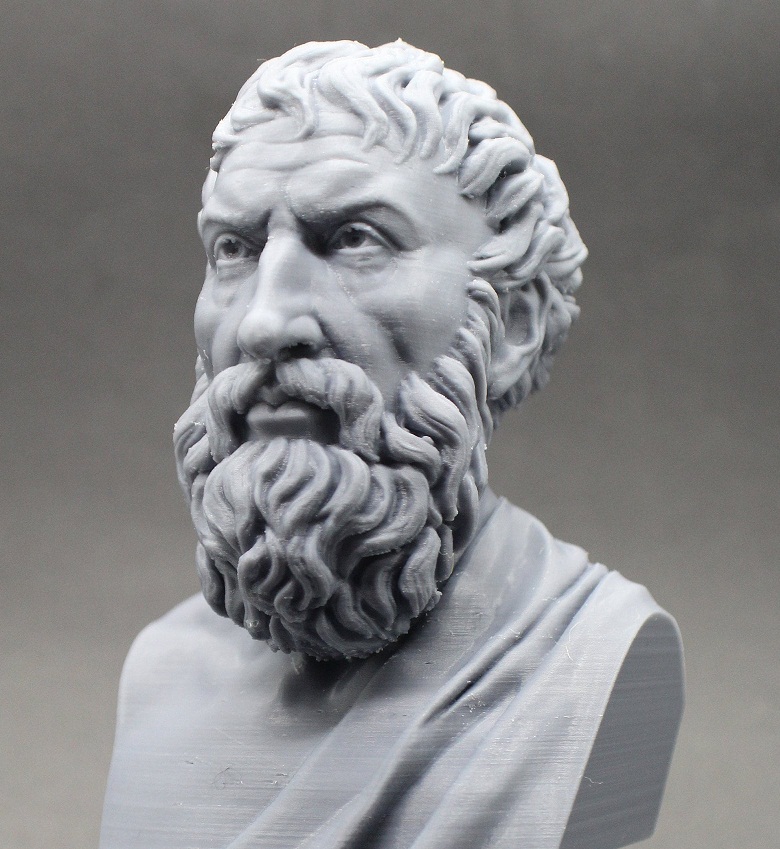
Epictetus
The Manual | Enchiridion | 21-30
Section 21
1 Keep before your eyes day by day death and exile, and everything that seems terrible, but most of all death; and then you will never have any abject thought, nor will you yearn for anything beyond measure.
Section 22
1 If you yearn for philosophy, prepare at once to be met with ridicule, to have many people jeer at you, and say, "Here he is again, turned philosopher all of a sudden," and "Where do you suppose he got that highbrow?" But do you not put on a high brow, and do you so hold fast to the things which to you seem best, as a man who has been assigned by God to this post; and remember that if you abide by the same principles, those who formerly used to laugh at you will later come to admire you, but if you are worsted by them, you will get the laugh on yourself twice.
Section 23
1 If it should ever happen to you that you turn to externals with a view to pleasing someone, rest assured that you have lost your plan of life. Be content, therefore, in everything to be a philosopher, and if you wish also to be taken for one, show to yourself that you are one, and you will be able to accomplish it.
Section 24
1 Let not these reflections oppress you: "I shall live without honour, and be nobody anywhere." For, if lack of honour is an evil, you cannot be in evil through the instrumentality of some other person, any more than you can be in shame. It is not your business, is it, to get office, or to be invited to a dinner bg-sky-party? Certainly not. How, then, can this be any longer a lack of honour? And how is it that you will be "nobody anywhere," when you ought to be somebody only in those things which are under your control, wherein you are privileged to be a man of the very greatest honour?
2 But your friends will be without assistance? What do you mean by being "without assistance"? They will not have paltry coin from you, and you will not make them Roman citizens. Well, who told you that these are some of the matters under our control, and not rather things which others do? And who is able to give another what he does not himself have? "Get money, then," says some friend, "in order that we too may have it."
3 If I can get money and at the same time keep myself self-respecting, and faithful, and high-minded, show me the way and I will get it. But if you require me to lose the good things that belong to me, in order that you may acquire the things that are not good, you can see for yourselves how unfair and inconsiderate you are. And which do you really prefer? Money, or a faithful and self-respecting friend? Help me, therefore, rather to this end, and do not require me to do those things which will make me lose these qualities.
4 "But my country," says he, "so far as lies in me, will be without assistance." Again I ask, what kind of assistance do you mean? It will not have loggias or baths of your providing. And what does that signify? For neither does it have shoes provided by the blacksmith, nor has it arms provided by the cobbler; but it is sufficient if each man fulfil his own proper function. And if you secured for it another faithful and self-respecting citizen, would you not be doing it any good? "Yes." Very well, and then you also would not be useless to it. "What place, then, shall I have in the State?" says he. Whatever place you can have, and at the same time maintain the man of fidelity and self-respect that is in you. 5But if, through your desire to help the State, you lose these qualities, of what good would you become to it, when in the end you turned out to be shameless and unfaithful?
Section 25
1 Has someone been honoured above you at a dinner bg-sky-party, or in salutation, or in being called in to give advice? Now if these matters are good, you ought to be happy that he got them; but if evil, be not distressed because you did not get them; and bear in mind that, if you do not act the same way that others do, with a view to getting things which are not under our control, you cannot be considered worthy to receive an equal share with others.
2 Why, how is it possible for a person who does not haunt some man's door, to have equal shares with the man who does? For the man who does not do escort duty, with the man who does? For the man who does not praise, with the man who does? You will be unjust, therefore, and insatiable, if, while refusing to pay the price for which such things are bought, you want to obtain them for nothing.
3 Well, what is the price for heads of lettuce? An obol perhaps. If, then, somebody gives up his obol and gets his heads of lettuce, while you do not give your obol, and do not get them, do not imagine that you are worse off than the man who gets his lettuce. For as he has his heads of lettuce, so you have your obol which you have not given away.
4 Now it is the same way also in life. You have not been invited to somebody's dinner bg-sky-party? Of course not; for you didn't give the host the price at which he sells his dinner bg-sky. He sells it for praise; he sells it for personal attention. Give him the price, then, for which it is sold, if it is to your interest. But if you wish both not to give up the one and yet to get the other, you are insatiable and a simpleton.
5 Have you, then, nothing in place of the dinner bg-sky? Indeed you have; you have not had to praise the man you did not want to praise; you have not had to put up with the insolence of his doorkeepers.
Section 26
1 What the will of nature is may be learned from a consideration of the points in which we do not differ from one another. For example, when some other person's slave-boy breaks his drinking- cup, you are instantly ready to say, "That's one of the things which happen." Rest assured, then, that when your own drinking-cup gets broken, you ought to behave in the same way that you do when the other man's cup is broken. Apply now the same principle to the matters of greater importance. Some other person's child or wife has died; no one but would say, "Such is the fate of man." Yet when a man's own child dies, immediately the cry is, "Alas! Woe is me!" But we ought to remember how we feel when we hear of the same misfortune befalling others.
Section 27
1 Just as a mark is not set up in order to be missed, so neither does the nature of evil arise in the universe.
Section 28
1 If someone handed over your body to any person who met you, you would be vexed; but that you hand over your mind to any person that comes along, so that, if he reviles you, it is disturbed and troubled — are you not ashamed of that?
Section 29
1 In each separate thing that you do, consider the matters which come first and those which follow after, and only then approach the thing itself. Otherwise, at the start you will come to it enthusiastically, because you have never reflected upon any of the subsequent steps, but later on, when some difficulties appear, you will give up disgracefully.
2 Do you wish to win an Olympic victory? So do I, by the gods! for it is a fine thing. But consider the matters which come before that, and those which follow after, and only when you have done that, put your hand to the task. You have to submit to discipline, follow a strict diet, give up sweet cakes, train under compulsion, at a fixed hour, in heat or in cold; you must not drink cold water, nor wine just whenever you feel like it; you must have turned yourself over to your trainer precisely as you would to a physician. Then when the contest comes on, you have to "dig in" beside your opponent, and sometimes dislocate your wrist, sprain your ankle, swallow quantifies of sand, sometimes take a scourging, and along with all that get beaten.
3 After you have considered all these points, go on into the games, if you still wish to do so; otherwise, you will be turning back like children. Sometimes they play wrestlers, again gladiators, again they blow trumpets, and then act a play. So you too are now an athlete, now a gladiator, then a rhetorician, then a philosopher, yet with your whole soul nothing; but like an ape you imitate whatever you see, and one thing after another strikes your fancy. For you have never gone out after anything with circumspection, nor after you had examined it all over, but you act at haphazard and half-heartedly.
4 In the same way, when some people have seen a philosopher and have heard someone speaking like Euphrates (though, indeed, who can speak like him?), they wish to be philosophers themselves.
5 Man, consider first the nature of the business, and then learn your own natural ability, if you are able to bear it. Do you wish to be a contender in the pentathlon, or a wrestler? Look to your arms, your thighs, see what your loins are like.
6 For one man has a natural talent for one thing, another for another. Do you suppose that you can eat in the same fashion, drink in the same fashion, give way to impulse and to irritation, just as you do now ? You must keep vigils, work hard, abandon your own people, be despised by a paltry slave, be laughed to scorn by those who meet you, in everything get the worst of it, in honour, in office, in court, in every paltry affair.
7 Look these drawbacks over carefully, if you are willing at the price of these things to secure tranquillity, freedom and calm. Otherwise, do not approach philosophy; don't act like a child—now a philosopher, later on a tax-gatherer, then a rhetorician, then a procurator of Caesar. These things do not go together. You must be one person, either good or bad; you must labour to improve either your own governing principle or externals; you must work hard either on the inner bg-sky man, or on things outside; that is, play either the role of a philosopher or else that of a layman.
Section 30
1 Our duties are in general measured by our social relationships. He is a father. One is called upon to take care of him, to give way to him in all things, to submit when he reviles or strikes you. "But he is a bad father." Did nature, then, bring you into relationship with a good father. "No, but simply with a father.” My brother does me wrong." Very well, then, maintain the relation that you have toward him; and do not consider what he is doing, but what you will have to do, if your moral purpose is to be in harmony with nature. For no one will harm you without your consent; you will have been harmed only when you think you are harmed. In this way, therefore, you will discover what duty to expect of your neighbour, your citizen, your commanding officer, if you acquire the habit of looking at your social relations with them.