Epictetus | The Manual | Enchiridion | 41-50
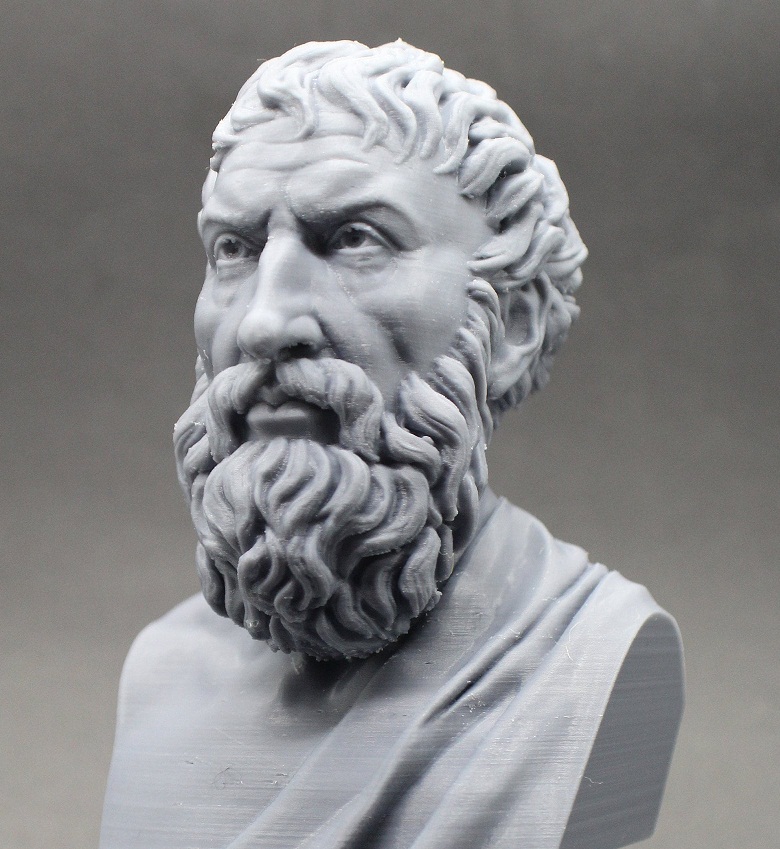
Epictetus
The Manual | Enchiridion | 41-50
Section 41
1 It is a mark of an ungifted man to spend a great deal of time in what concerns his body, as in much exercise, much eating, much drinking, much evacuating of the bowels, much copulating. But these things are to be done in passing; and let your whole attention be devoted to the mind.
Section 42
1 When someone treats you ill or speaks ill of you, remember that he acts or speaks thus because he thinks it is incumbent upon him. That being the case, it is impossible for him to follow what appears good to you, but what appears good to himself; whence it follows, that, if he gets a wrong view of things, the man that suffers is the man that has been deceived. For if a person thinks a true composite judgement to be false, the composite judgement does not suffer, but the person who has been deceived. If, therefore, you start from this point of view, you will be gentle with the man who reviles you. For you should say on each occasion, "He thought that way about it."
Section 43
1 Everything has two handles, by one of which it ought to be carried and by the other not. If your brother wrongs you, do not lay hold of the matter by the handle of the wrong that he is doing, because this is the handle by which the matter ought not to be carried; but rather by the other handle — that he is your brother, that you were brought up together, and then you will be laying hold of the matter by the handle by which it ought to be carried.
Section 44
1 The following statements constitute a non sequitur: "I am richer than you are, therefore I am superior to you"; or, "I am more eloquent than you are, therefore I am superior to you." But the following conclusions are better: "I am richer than you are, therefore my property is superior to yours"; or, "I am more eloquent than you are, therefore my elocution is superior to yours." But you are neither property nor elocution.
Section 45
1 Somebody is hasty about bathing; do not say that he bathes badly, but that he is hasty about bathing. Somebody drinks a good deal of wine; do not say that he drinks badly, but that he drinks a good deal. For until you have decided what judgement prompts him, how do you know that what he is doing is bad? And thus the final result will not be that you receive convincing sense-impressions of some things, but give your assent to others.
Section 46
1 On no occasion call yourself a philosopher, and do not, for the most part, talk among laymen about your philosophic principles, but do what follows from your principles. For example, at a banquet do not say how people ought to eat, but eat as a man ought. For remember how Socrates had so completely eliminated the thought of ostentation, that people came to him when they wanted him to introduce them to philosophers, and he used to bring them along. So well did he submit to being overlooked.
2 And if talk about some philosophic principle arises among laymen, keep silence for the most part, for there is great danger that you will spew up immediately what you have not digested. So when a man tells you that you know nothing, and you, like Socrates, are not hurt, then rest assured that you are making a beginning with the business you have undertaken. For sheep, too, do not bring their fodder to the shepherds and show how much they have eaten, but they digest their food within them, and on the outside produce wool and milk. And so do you, therefore, make no display to the laymen of your philosophical principles, but let them see the results which come from these principles when digested.
Section 47
1 When you have become adjusted to simple living in regard to your bodily wants, do not preen yourself about the accomplishment; and so likewise, if you are a water-drinker, do not on every occasion say that you are a water-drinker. And if ever you want to train to develop physical endurance, do it by yourself and not for outsiders to behold; do not throw your arms around statues, but on occasion, when you are very thirsty, take cold water into your mouth, and then spit it out, without telling anybody.
Section 48
1 This is the position and character of a layman: He never looks for either help or harm from himself, but only from externals. This is the position and character of the philosopher: He looks for all his help or harm from himself.
2 Signs of one who is making progress are: He censures no one, praises no one, blames no one, finds fault with no one, says nothing about himself as though he were somebody or knew something. When he is hampered or prevented, he blames himself. And if anyone compliments him, he smiles to himself at the person complimenting; while if anyone censures him, he makes no defence. He goes about like an invalid, being careful not to disturb, before it has grown firm, any part which is getting well.
3 He has put away from himself his every desire, and has transferred his aversion to those things only, of what is under our control, which are contrary to nature. He exercises no pronounced choice in regard to anything. If he gives the appearance of being foolish or ignorant he does not care. In a word, he keeps guard against himself as though he were his own enemy lying in wait.
Section 49
1 When a person gives himself airs because he can understand and interpret the books of Chrysippus, say to yourself, "If Chrysippus had not written obscurely, this man would have nothing about which to give himself airs."
But what is it I want? To learn nature and to follow her. I seek, therefore, someone to interpret her; and having heard that Chrysippus does so, I go to him. But I do not understand what he has written; I seek, therefore, the person who interprets Chrysippus. And down to this point there is nothing to justify pride. But when I find the interpreter, what remains is to put his precepts into practice; this is the only thing to be proud about. If, however, I admire the mere act of interpretation, what have I done but turned into a grammarian instead of a philosopher? The only difference, indeed, is that I interpret Chrysippus instead of Homer. Far from being proud, therefore, when somebody says to me, "Read me Chrysippus," I blush the rather, when I am unable to show him such deeds as match and harmonize with his words.
Section 50
1 Whatever principles are set before you, stand fast by these like laws, feeling that it would be impiety for you to transgress them. But pay no attention to what somebody says about you, for this is, at length, not under your control.