Empedocles
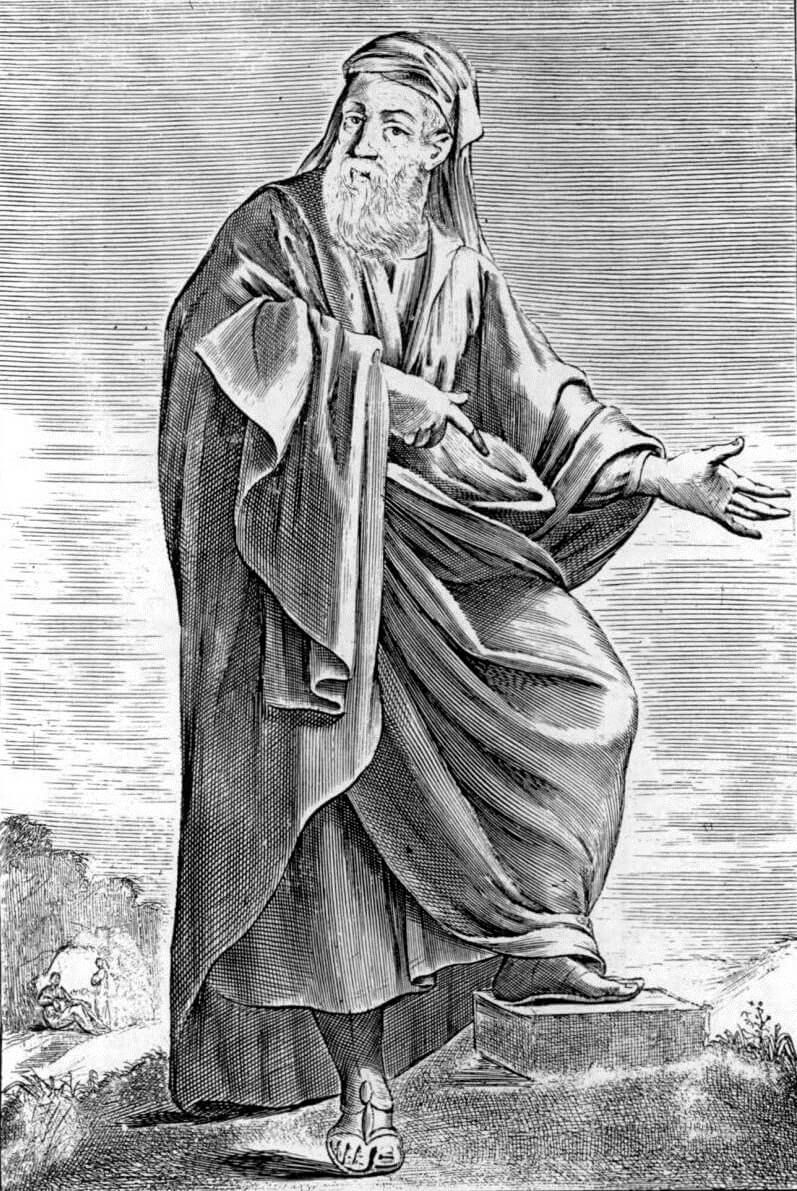
1. Empedocles
Empedocles (Ἐμπεδοκλῆς; c. 494 – c. 434 BC) was a Greek pre-Socratic philosopher and a native citizen of Akragas, a Greek city in Sicily (now Agrigento).
Empedocles' philosophy is best known for originating the cosmogonic theory of the 4 classical elements.
He also proposed forces he called Love and Strife which would mix and separate the elements, respectively.
Influenced by Pythagoras (died c. 495 BC) and the Pythagoreans, Empedocles challenged the practice of animal sacrifice and killing animals for food.
He developed a distinctive doctrine of reincarnation.
He is generally considered the last Greek philosopher to have recorded his ideas in verse. Some of his work survives, more than is the case for any other pre-Socratic philosopher.
Empedocles' death was mythologized by ancient writers, and has been the subject of a number of literary treatments.
2. Life
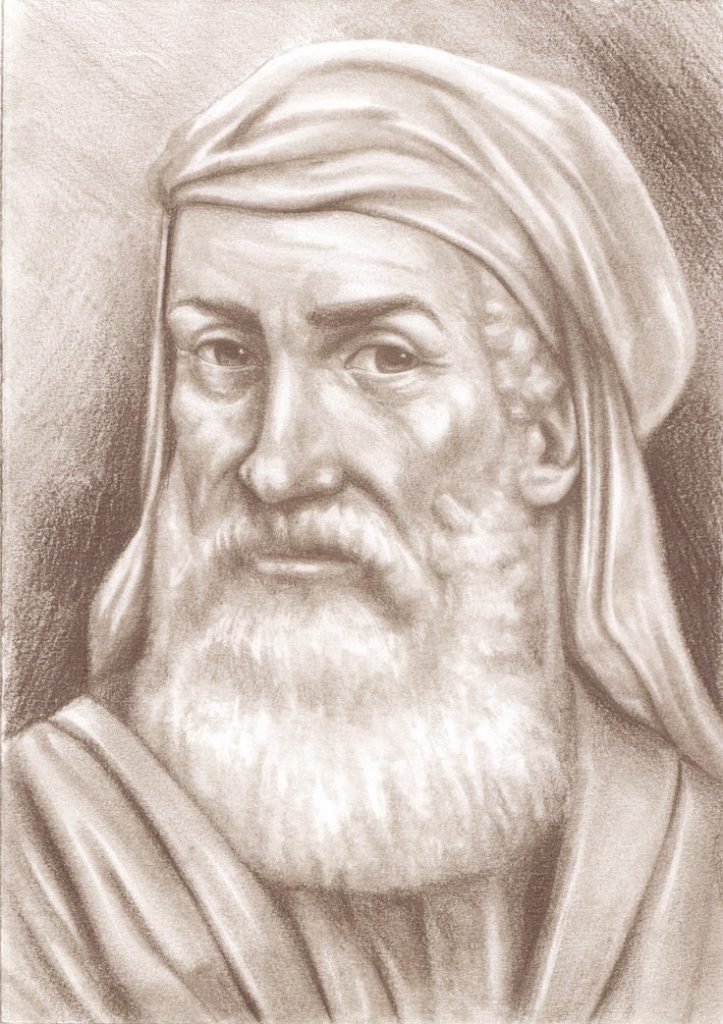
Empedocles (c.494 – c.434 BC)
Empedocles was a native citizen of Akragas in Sicily. He came from a rich and noble family. Very little is known about his life.
His grandfather, also called Empedocles, had won a victory in the horse-race at Olympia in the 71st Olympiad (496–95 BC).
His father's name, according to the best accounts, was Meton.
All that can be said to be known about the dates of Empedocles is, that his grandfather was still alive in 496 BC; that he himself was active at Akragas after 472 BC, the date of Theron’s death; and that he died later than 444 BC.
Empedocles is said to have been magnanimous in his support of the poor; severe in persecuting the overbearing conduct of the oligarchs; and he even declined the sovereignty of the city when it was offered to him.
According to scholars:
there is another side to his public character ... He claimed to be a God, and to receive the homage of his fellow-citizens in that capacity.
The truth is, Empedocles was not a mere statesman; he had a good deal of the 'medicine-man' about him. ... We can see what this means from the fragments of the Purifications.
Empedocles was a preacher of the new religion which sought to secure release from the 'wheel of birth' by purity and abstinence.
Orphism seems to have been strong at Akragas in the days of Theron, and there are even some verbal coincidences between the poems of Empedocles and the Odes of Orphism which Pindar addressed to that prince.
His brilliant oratory, his penetrating knowledge of nature, and the reputation of his marvellous powers, including the curing of diseases, and averting epidemics, produced many myths and stories surrounding his name.
In his poem Purifications
he claimed miraculous powers, including the destruction of evil, the curing of old age, and the controlling of wind and rain.
Empedocles was acquainted or connected by friendship with the physician Pausanias of Sicily, and with various Pythagoreans; and even, it is said, with Parmenides and Anaxagoras.
The only pupil of Empedocles who is mentioned is the sophist and rhetorician Gorgias.
Timaeus and Dicaearchus spoke of the journey of Empedocles to the Peloponnese, and of the admiration, which was paid to him there;
others mentioned his stay at Athens, and in the newly founded colony of Thurii, 446 BC (now in Calabria, Italy);
there are also fanciful reports of him travelling far to the east to the lands of the Magi (Persian Zoroastrians).
3. Death
According to Aristotle, he died at the age of 60 (c. 430 BC), even though other writers have him living up to the age of 109.
Likewise, there are myths concerning his death: a tradition, which is traced to Heraclides Ponticus, represented him as having been removed from the Earth; whereas others had him perishing in the flames of Mount Etna.
According to scholars:
We are told that Empedocles leapt into the crater of Etna that he might be deemed a God.
This appears to be a malicious version of a tale set on foot by his adherents that he had been snatched up to Heaven in the night.
Both stories would easily get accepted; for there was no local tradition.
Empedocles did not die in Sicily, but in the Peloponnese, or, perhaps, at Thurii. It is not at all unlikely that he visited Athens. ...
Timaeus refuted the common stories about Empedocles at some length:
He was quite positive that Empedocles never returned to Sicily after he went to Olympia to have his poem recited to the Hellenes.
The plan for the colonisation of Thurii would, of course, be discussed at Olympia, and we know that Greeks from the Peloponnese and elsewhere joined it. He may very well have gone to Athens in connexion with this.
4. Works
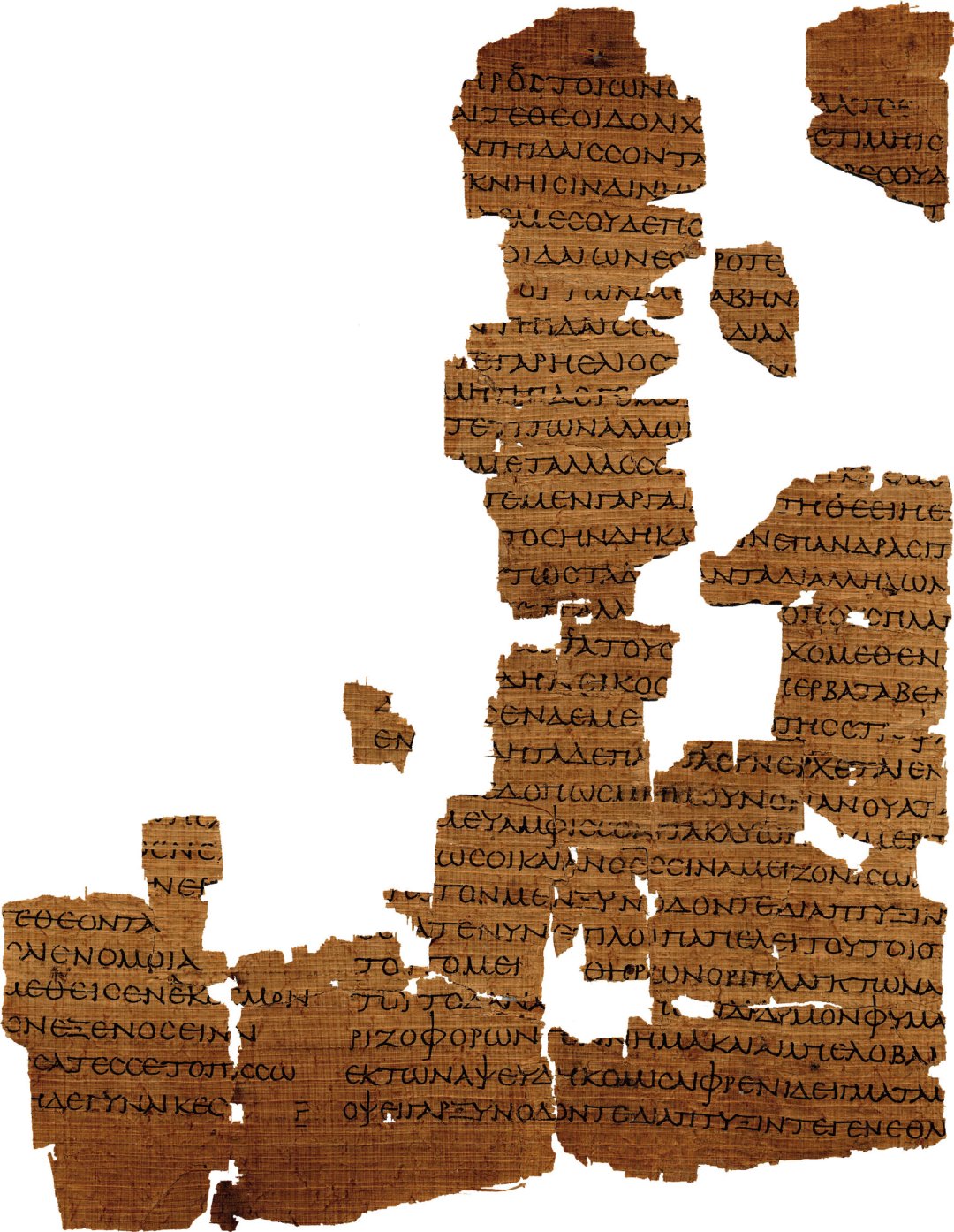
Strasbourg Empedocles papyrus in the Bibliothèque nationale et universitaire, Strasbourg
Empedocles is considered the last Greek philosopher to write in verse.
There is a debate about whether the surviving fragments of his teaching should be attributed to 2 separate poems, Purifications
and On Nature
, with different subject matter,
or whether they may all derive from one poem with 2 titles, or whether one title refers to part of the whole poem.
Some scholars argue that the title Purifications
refers to the 1st part of a larger work called (as a whole) On Nature
.
There is also a debate about which fragments should be attributed to each of the poems, if there are 2 poems, or if part of it is called Purifications
; because ancient writers rarely mentioned which poem they were quoting.
Empedocles was undoubtedly acquainted with the didactic poems of Xenophanes and Parmenides—allusions to the latter can be found in the fragments—
but he seems to have surpassed them in the animation and richness of his style, and in the clearness of his descriptions and diction.
Aristotle called him the father of rhetoric, and, although he acknowledged only the meter as a point of comparison between the poems of Empedocles and the epics of Homer, he described Empedocles as Homeric and powerful in his diction.
Lucretius speaks of him with enthusiasm, and evidently viewed him as his model. The two poems together comprised 5000 lines. About 550 lines of his poetry survive.
Purifications
In the old editions of Empedocles, only about 100 lines were typically ascribed to his Purifications
, which was taken to be a poem about ritual purification, or the poem that contained all his religious and ethical thought.
Early editors supposed that it was a poem that offered a mythical account of the world which may, nevertheless, have been part of Empedocles' philosophical system.
According to Diogenes Laertius it began with the following verses:
Friends who inhabit the mighty town by tawny Akragas
which crowns the citadel, caring for good deeds,
greetings; I, an immortal God, no longer mortal,
wander among you, honoured by all,
adorned with holy diadems and blooming garlands.
To whatever illustrious towns I go,
I am praised by men and women, and accompanied
by thousands, who thirst for deliverance,
some ask for prophecies, and some entreat,
for remedies against all kinds of disease.
In the older editions, it is to this work that editors attributed the story about souls, where we are told that there were once spirits who lived in a state of bliss,
but having committed a crime they were punished by being forced to become mortal beings, reincarnated from body to body.
Humans, animals, and even plants are such Spirits.
The moral conduct recommended in the poem may allow us to become like Gods again.
If, as is now widely held, this title Purifications
refers to the poem On Nature
, or to a part of that poem, this story will have been at the beginning of the main work on nature and the cosmic cycle.
The relevant verses are also sometimes attributed to the poem of On Nature
, even by those who think that there was a separate poem called Purifications
.
On Nature
There are about 450 lines of his poem On Nature
extant, including 70 lines which have been reconstructed from some papyrus scraps known as the Strasbourg papyrus.
The poem originally consisted of 2000 lines of hexameter verse, and was addressed to Pausanias. It was this poem which outlined his philosophical system.
In it, Empedocles explains not only the nature and history of the universe, including his theory of the 4 classical elements, but he describes theories on causation, perception, and thought, as well as explanations of terrestrial phenomena and biological processes.
5. Philosophy
Although acquainted with the theories of the Eleatics and the Pythagoreans, Empedocles did not belong to any one definite school.
An eclectic in his thinking, he combined much that had been suggested by Parmenides, Pythagoras and the Ionian schools.
He was a firm believer in Orphic mysteries, as well as a scientific thinker and a precursor of physics.
Aristotle mentions Empedocles among the Ionic philosophers, and he places him in very close relation to the atomist philosophers and to Anaxagoras.
Empedocles, like the Ionian philosophers and the atomists, continued the tradition of tragic thought which tried to find the basis of the relationship of the One and the Many.
Each of the various philosophers, following Parmenides, derived from the Eleatics, the conviction that an existence could not pass into non-existence, and vice versa.
Yet, each one had his peculiar way of describing this relation of Divine and mortal thought and thus of the relation of the One and the Many.
In order to account for change in the world, in accordance with the ontological requirements of the Eleatics, they viewed changes as the result of mixture and separation of unalterable fundamental realities.
Empedocles held that the 4 elements (Water, Air, Earth, and Fire) were those unchangeable fundamental realities, which were themselves transfigured into successive worlds by the powers of Love and Strife.
The 4 elements
Empedocles established 4 ultimate elements which make all the structures in the world—
- Fire,
- Air,
- Water,
- Earth.
Empedocles called these 4 elements roots
, which he also identified with the mythical names of Zeus, Hēra, Nestis (Persephone), and Aidoneus, e.g.,
Now hear the 4-fold roots of everything: enlivening Hēra, Hades, shining Zeus. And Nestis, moistening mortal springs with tears
.
Empedocles never used the term element
(στοιχεῖον, stoicheion), which seems to have been first used by Plato.
According to the different proportions, in which these 4 indestructible and unchangeable elements are combined with each other, the difference of the structure is produced.
It is in the aggregation and segregation of elements thus arising, that Empedocles, like the atomists, found the real process which corresponds to what is popularly termed growth, increase or decrease.
Nothing new comes or can come into being; the only change that can occur is a change in the juxtaposition of element with element.
This theory of the 4 elements became the standard dogma for the next 2 000 years.
Love and Strife
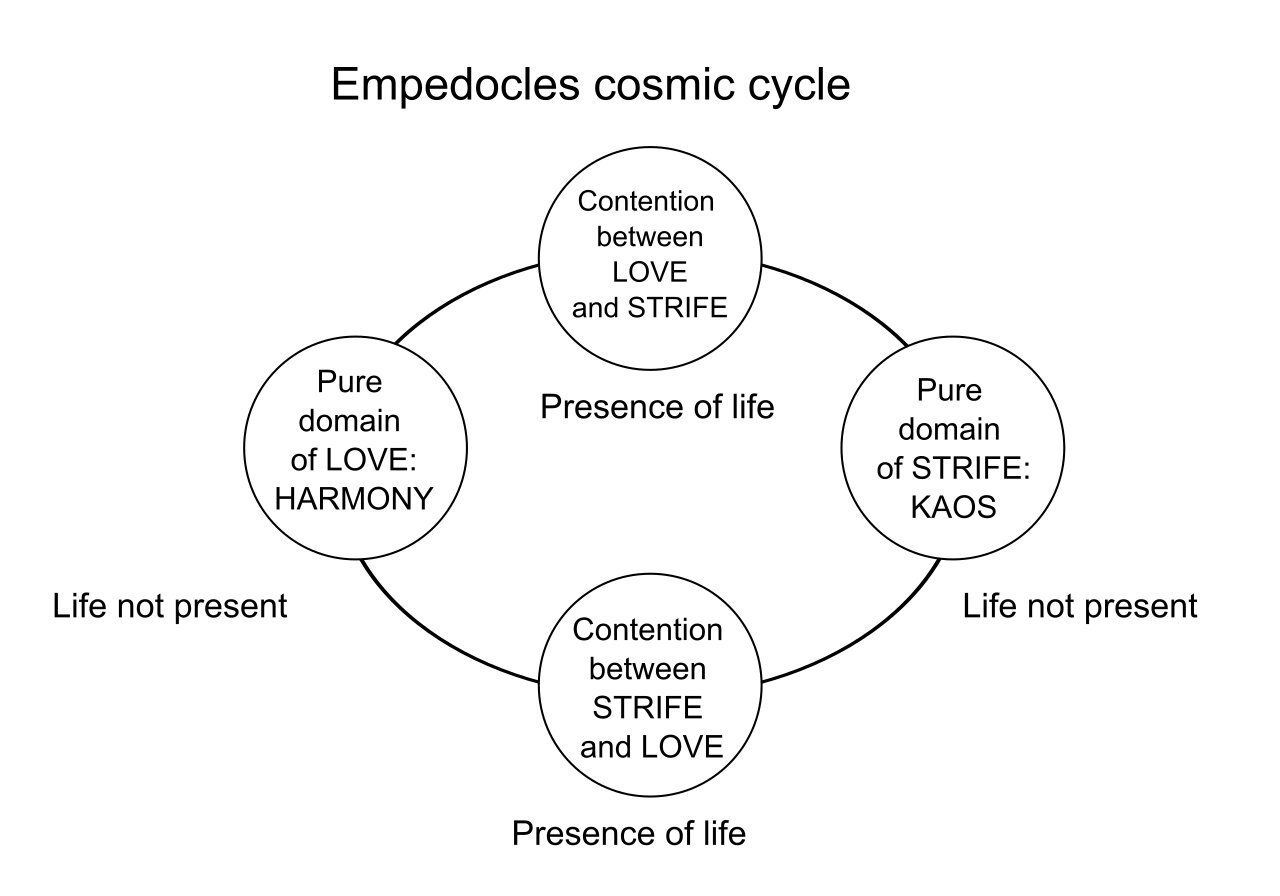
Empedocles' cosmic cycle
Love & Strife
The 4 elements, however, are simple, eternal, and unalterable, and as change is the consequence of their mixture and separation, it was also necessary to suppose the existence of moving powers that bring about mixture and separation.
The 4 elements are both eternally brought into Union and Parted from one another by 2 divine powers, Love and Strife ((φιλότης) and (νεῖκος)).
Love (φιλότης) is responsible for the attraction of different forms of what we now call matter, and Strife (νεῖκος) is the cause of their separation.
If the 4 elements make up the universe, then Love and Strife explain their variation and harmony.
Love and Strife are attractive and repulsive forces, respectively, which are plainly observable in human behaviour, but also pervade the universe.
The 2 forces wax and wane in their dominance, but neither force ever wholly escapes the imposition of the other.
Empedocles sometimes gave an efficient power to Love and Strife, and sometimes put them on a level with the other 4.
The fragments leave no room for doubt that they were thought of as spatial and corporeal.
Love is said to be equal in length and breadth
to the others, and Strife is described as equal to each of them in weight (fr. 17).
These physical speculations were part of a history of the universe which also dealt with the origin and development of life.
The sphere of Empedocles
As the best and original state, there was a time when the pure elements and the 2 powers co-existed in a condition of rest and inertness in the form of a sphere.
The elements existed together in their purity, without mixture and separation, and the uniting power of Love predominated in the sphere: the separating power of Strife guarded the extreme edges of the sphere.
Since that time, Strife gained more sway and the bond which kept the pure elementary substances together in the sphere was dissolved.
The elements became the world of phenomena we see today, full of contrasts and oppositions, operated on by both Love and Strife.
The Sphere of Empedocles being the embodiment of pure existence is the embodiment or representative of God.
Empedocles assumed a cyclical universe whereby the elements return and prepare the formation of the sphere for the next period of the universe.
Cosmogony
Empedocles attempted to explain the separation of elements, the formation of earth and sea, of Sun and Moon, of atmosphere.
He also dealt with the first origin of plants and animals, and with the physiology of humans.
As the elements entered into combinations, there appeared strange results—heads without necks, arms without shoulders.
Then as these fragmentary structures met, there were seen horned heads on human bodies, bodies of oxen with human heads, and figures of double sex.
But most of these products of natural forces disappeared as suddenly as they arose; only in those rare cases where the parts were found to be adapted to each other did the complex structures last.
Thus the organic universe sprang from spontaneous aggregations that suited each other as if this had been intended.
Soon various influences reduced creatures of double sex to a male and a female, and the world was replenished with organic life.
It is possible to see this theory as an anticipation of Charles Darwin's theory of natural selection, although Empedocles was not trying to explain evolution.
Perception and knowledge
Empedocles is credited with the first comprehensive theory of light and vision.
Empedocles suggested that light takes time to pass from one point to another.
He put forward the idea that we see objects because light streams out of our eyes and touches them.
While flawed, this became the fundamental basis on which later Greek philosophers and mathematicians like Euclid would construct some of the most important theories of light, vision, and optics.
Knowledge is explained by the principle that elements in the things outside us are perceived by the corresponding elements in ourselves. Like is known by like.
The whole body is full of pores and hence respiration takes place over the whole frame.
In the organs of sense these pores are specially adapted to receive the effluences which are continually rising from bodies around us; thus perception occurs.
In vision, certain particles go forth from the eye to meet similar particles given forth from the object, and the resultant contact constitutes vision.
Perception is not merely a passive reflection of external objects.
Empedocles noted the limitation and narrowness of human perceptions:
We see only a part but fancy that we have grasped the whole. But the senses cannot lead to truth; thought and reflection must look at the thing from every side.
It is the business of a philosopher, while laying bare the fundamental difference of elements, to show the identity that exists between what seem unconnected parts of the universe.
Respiration
In a famous fragment, Empedocles attempted to explain the phenomenon of respiration by means of an elaborate analogy with the clepsydra, an ancient device for conveying liquids from one vessel to another.
This fragment has sometimes been connected to a passage in Aristotle's Physics where Aristotle refers to people who twisted wineskins and captured Air in clepsydras to demonstrate that void does not exist.
There is, however, no evidence that Empedocles performed any experiment with clepsydras. The fragment certainly implies that Empedocles knew about the corporeality of Air, but he says nothing whatever about the Void.
The clepsydra was a common utensil and everyone who used it must have known, in some sense, that the invisible Air could resist liquid.
Reincarnation
Like Pythagoras, Empedocles believed in the transmigration of the soul/metempsychosis, that souls can be reincarnated between humans, animals and even plants.
For Empedocles, all living things were on the same spiritual plane; plants and animals are links in a chain where humans are a link too.
Empedocles was a vegetarian and advocated vegetarianism, since the bodies of animals are the dwelling places of punished Souls.
Wise people, who have learned the secret of life, are next to the divine, and their souls, free from the cycle of reincarnations, are able to rest in happiness for eternity.
6. Legend of death

Empedocles monument,
in Vienna, Austria,
Naturhistorisches Museum
Diogenes Laertius records the legend
that Empedocles died by throwing himself into Mount Etna in Sicily, so that the people would believe his body had vanished and he had turned into an immortal god; the volcano, however, threw back one of his bronze sandals, revealing the deceit.
Another legend maintains that he threw himself into the Volcano to prove to his disciples that he was immortal; he believed he would come back as a God after being consumed by the fire.
In Icaro-Menippus, a comedic dialogue written by the 2nd century satirist Lucian of Samosata, Empedocles' final fate is re-evaluated:
Rather than being incinerated in the fires of Mount Etna, he was carried up into the Heavens by a Volcanic eruption.
Although a bit singed by the ordeal, Empedocles survives and continues his life on the Moon, surviving by feeding on dew.
In Matthew Arnold's poem Empedocles on Etna, a narrative of the philosopher's last hours before he jumps to his death in the crater, first published in 1852, Empedocles predicts:
To the elements it came from
Everything will return.
Our bodies to earth,
Our blood to water,
Heat to fire,
Breath to air.
In 2006, a massive underwater volcano 40km off the coast of Sicily was named Empedocles.