Epictetus | The Manual | Enchiridion | 31-40
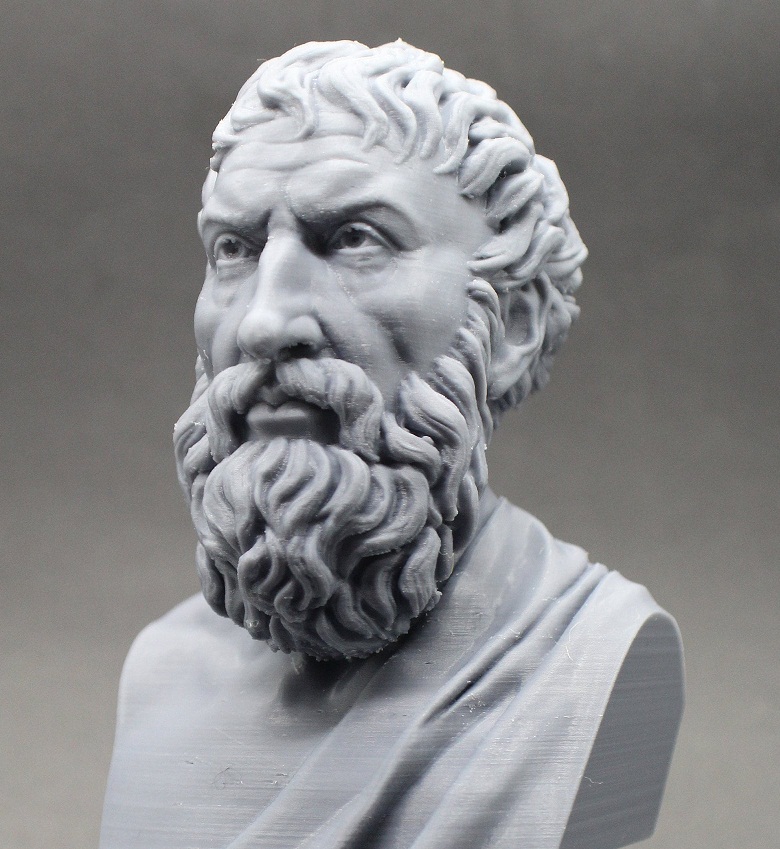
Epictetus
The Manual | Enchiridion | 31-40
Section 31
1 In piety towards the gods, I would have you know, the chief element is this, to have right opinions about them — as existing and as administering the universe well and justly — and to have set yourself to obey them and to submit to everything that happens, and to follow it voluntarily, in the belief that it is being fulfilled by the highest intelligence. For if you act in this way, you will never blame the gods, nor find fault with them for neglecting you.
2 But this result cannot be secured in any other way than by withdrawing your idea of the good and the evil from the things which are not under our control, and placing it in those which are under our control, and in those alone. Because, if you think any of those former things to be good or evil, then, when you fail to get what you want and fall into what you do not want, it is altogether inevitable that you will blame and hate those who are responsible for these results.
3 For this is the nature of every living creature, to flee from and to turn aside from the things that appear harmful, and all that produces them, and to pursue after and to admire the things that are helpful, and all that produces them. Therefore, it is impossible for a man who thinks that he is being hurt to take pleasure in that which he thinks is hurting him, just as it is also impossible for him to take pleasure in the hurt itself.
4 Hence it follows that even a father is reviled by a son when he does not give his child some share in the things that seem to be good ; and this it was which made Polyneices and Eteocles enemies of one another, the thought that the royal power was a good thing. That is why the farmer reviles the gods, and so also the sailor, and the merchant, and those who have lost their wives and their children. For where a man's interest lies, there is also his piety. Wherefore, whoever is careful to exercise desire and aversion as he should, is at the same time careful also about piety.
5 But it is always appropriate to make libations, and sacrifices, and to give of the first fruits after the manner of our fathers, and to do all this with purity, and not in a slovenly or careless fashion, nor, indeed, in a niggardly way, nor yet beyond our means.
Section 32
1 When you have recourse to divination, remember that you do not know what the issue is going to be, but that you have come in order to find this out from the diviner; yet if you are indeed a philosopher, you know, when you arrive, what the nature of it is. For if it is one of the things which are not under our control, it is altogether necessary that what is going to take place is neither good nor evil.
2 Do not, therefore, bring to the diviner desire or aversion, and do not approach him with trembling, but having first made up your mind that every issue is indifferent and nothing to you, but that, whatever it may be, it will be possible for you to turn it to good use, and that no one will prevent this. Go, then, with confidence to the gods as to counsellors; and after that, when some counsel has been given you, remember whom you have taken as counsellors, and whom you will be disregarding if you disobey.
3 But go to divination as Socrates thought that men should go, that is, in cases where the whole inquiry has reference to the outcome, and where neither from reason nor from any other technical art are means vouchsafed for discovering the matter in question. Hence, when it is your duty to share the danger of a friend or of your country, do not ask of the diviner whether you ought to share that danger. For if the diviner forewarns you that the omens of sacrifice have been unfavourable, it is clear that death is portended, or the injury of some member of your body, or exile; yet reason requires that even at this risk you are to stand by your friend, and share the danger with your country. Wherefore, give heed to the greater diviner, the Pythian Apollo, who cast out of his temple the man who had not helped his friend when he was being murdered.
Section 33
1Lay down for yourself, at the outset, a certain stamp and type of character for yourself, which you are to maintain whether you are by yourself or are meeting with people.
2 And be silent for the most part, or else make only the most necessary remarks, and express these in few words. But rarely, and when occasion requires you to talk, talk, indeed, but about no ordinary topics. Do not talk about gladiators, or horse-races, or athletes, or things to eat or drink — topics that arise on all occasions; but above all, do not talk about people, either blaming, or praising, or comparing them.
3 If, then, you can, by your own conversation bring over that of your companions to what is seemly. But if you happen to be left alone in the presence of aliens, keep silence.
4 Do not laugh much, nor at many things, nor boisterously.
5 Refuse, if you can, to take an oath at all, but if that is impossible, refuse as far as circumstances allow.
6 Avoid entertainments given by outsiders and by persons ignorant of philosophy; but if an appropriate occasion arises for you to attend, be on the alert to avoid lapsing into the behaviour of such laymen. For you may rest assured, that, if a man's companion be dirty, the person who keeps close company with him must of necessity get a share of his dirt, even though he himself happens to be clean.
7 In things that pertain to the body take only as much as your bare need requires, I mean such things as food, drink, clothing, shelter, and household slaves; but cut down everything which is for outward show or luxury.
8 In your sex-life preserve purity, as far as you can, before marriage, and, if you indulge, take only those privileges which are lawful. However, do not make yourself offensive, or censorious, to those who do indulge, and do not make frequent mention of the fact that you do not yourself indulge.
9 If someone brings you word that So-and-so is speaking ill of you, do not defend yourself against what has been said, but answer, "Yes, indeed, for he did not know the rest of the faults that attach to me; if he had, these would not have been the only ones he mentioned."
10 It is not necessary, for the most part, to go to the public shows. If, however, a suitable occasion ever arises, show that your principal concern is for none other than yourself, which means, wish only for that to happen which does happen, and for him only to win who does win; for so you will suffer no hindrance. But refrain utterly from shouting, or laughter at anyone, or great excitement. And after you have left, do not talk a great deal about what took place, except in so far as it contributes to your own improvement; for such behaviour indicates that the spectacle has aroused your admiration.
11 Do not go rashly or readily to people's public readings, but when you do go, maintain your own dignity and gravity, and at the same time be careful not to make yourself disagreeable.
12 When you are about to meet somebody, in particular when it is one of those men who are held in very high esteem, propose to yourself the question, “What would Socrates or Zeno have done under these circumstances?" and then you will not be at a loss to make proper use of the occasion.
13 When you go to see one of those men who have great power, propose to yourself the thought, that you will not find him at home, that you will be shut out, that the door will be slammed in your face, that he will pay no attention to you. And if, despite all this, it is your duty to go, go and take what comes, and never say to yourself, “It was not worth all the trouble." For this is characteristic of the layman, that is, a man who is vexed at externals.
14 In your conversation avoid making mention at great length and excessively of your own deeds or dangers, because it is not as pleasant for others to hear about your adventures, as it is for you to call to mind your own dangers.
15 Avoid also raising a laugh, for this is a kind of behaviour that slips easily into vulgarity, and at the same time is calculated to lessen the respect which your neighbours have of you. It is dangerous also to lapse into foul language. 16When, therefore, anything of the sort occurs, if the occasion be suitable, go even so far as to reprove the person who has made such a lapse; if, however, the occasion does not arise, at all events show by keeping silence, and blushing, and frowning, that you are displeased by what has been said.
Section 34
1 When you get an external impression of some pleasure, guard yourself, as with impressions in general, against being carried away by it; nay, let the matter wait upon your leisure, and give yourself a little delay. Next think of the two periods of lime, first, that in which you will enjoy your pleasure, and second, that in which, after the enjoyment is over, you will later repent and revile your own self; and set over against these two periods of time how much joy and self-satisfaction you will get if you refrain. However, if you feel that a suitable occasion has arisen to do the deed, be careful not to allow its enticement, and sweetness, and attractiveness to overcome you; but set over against all this the thought, how much better is the consciousness of having won a victory over it.
Section 35
1 When you do a thing which you have made up your mind ought to be done, never try not to be seen doing it, even though most people are likely to think unfavourably about it. If, however, what you are doing is not right, avoid the deed itself altogether; but if it is right, why fear those who are going to rebuke you wrongly?
Section 36
1 Just as the propositions, "It is day," and "It is night," are full of meaning when separated, but meaningless if united; so also, granted that for you to take the larger share at a dinner bg-sky is good for your body, still, it is bad for the maintenance of the proper kind of social feeling. When, therefore, you are eating with another person, remember to regard, not merely the value for your body of what lies before you, but also to maintain your respect for your host.
Section 37
1 If you undertake a role which is beyond your powers, you both disgrace yourself in that one, and at the same time neglect the role which you might have filled with success.
Section 38
1 Just as you are careful, in walking about, not to step on a nail or to sprain your ankle, so be careful also not to hurt your governing principle. And if we observe this rule in every action, we shall be more secure in setting about it.
Section 39
1 Each man's body is a measure for his property, just as the foot is a measure for his shoe. If, then, you abide by this principle, you will maintain the proper measure, but if you go beyond it, you cannot help but fall headlong over a precipice, as it were, in the end. So also in the case of your shoe; if once you go beyond the foot, you get first a gilded shoe, then a purple one, then an embroidered one. For once you go beyond the measure there is no limit.
Section 40
1 Immediately after they are fourteen, women are called "ladies " by men. And so when they see that they have nothing else but only to be the bedfellows of men, they begin to beautify themselves, and put all their hopes in that. It is worth while for us to take pains, therefore, to make them understand that they are honoured for nothing else but only for appearing modest and self-respecting.